Small Acreage Homesteading: How to Build a Thriving, Self-Sufficient Life on Limited Land

Updated: Jun 21

Most people don’t realize how much a single acre can actually do until they start using it well.
It’s easy to look at a small property and think in terms of limits — not enough space, not enough room for animals, not enough to grow real food. But small-acreage homesteading flips that mindset. It’s not about having more land. It’s about building smarter systems on the land you already have.
Some of the most efficient, productive, and thoughtfully designed homesteads are built on just a few acres — sometimes even less.
At Inka’s Acres, we’ve learned firsthand that small-acreage homesteading isn’t about how much land you have. It’s about how intentionally you use it. With the right systems in place, you can raise animals, grow food, and move toward self-sufficient living without needing a massive footprint.
And if there’s one animal that makes this lifestyle especially doable on limited land? It’s goats.
What Is Small Acreage Homesteading? (And Why It’s More Possible Than You Think)
Small acreage homesteading typically refers to managing a productive home system on anywhere from 1 to 10 acres — though plenty of people make it work on even less.
It’s not about doing everything. It’s about doing the right things for your space.
Instead of spreading out, you’re layering systems:
Animals that support your land
Gardens that feed both you and your animals
Infrastructure that works double-duty
Self-sufficient living also isn’t all-or-nothing. You don’t wake up one day producing 100% of your food and living off grid. It’s a progression — one system at a time.
Maybe you start with a small garden. Then add a few chickens. Then some bees. Then a few goats. Over time, those pieces begin to work together, and suddenly your “small” homestead is producing more than you expected.
Why Small Homesteads Are on the Rise
More people are rethinking how they live — and how dependent they want to be on external systems.
Food costs are rising. Supply chains feel less predictable. And there’s a growing desire to reconnect with where food actually comes from.
They want to know what they’re eating, how it was raised, and where it came from. But they don’t necessarily want (or need) a full-scale farm to get there.
Small homesteads hit that middle ground:
Manageable
Scalable
Grounded in real life
You can build one alongside a job, a family, and everything else you’ve got going on — which is exactly why more people are doing it.
Designing a Productive Small Acreage Homestead

When space is limited, design matters more than anything.
This is where small homesteads either thrive — or become chaotic.
Prioritizing Space (Because You Don’t Have Much of It)
Break your land into flexible zones:
Animal areas
Garden space
Storage
Living areas
But don’t treat them as fixed. The most effective homesteads blur those lines.
Designing Double-Use Spaces That Actually Work
This is where small acreage really shines.
Instead of dedicating space to one purpose, you let it evolve throughout the year:
Rotational grazing + soil improvement - Goats can clear brush or overgrowth in areas you plan to garden later. They do the hard work, fertilize the soil, and reduce your labor.
Chicken tractors in garden beds - After harvest, move meat chickens or laying hens through your garden. They:
Eat pests
Turn over soil
Add manure
Shared shelter zones (carefully planned) - While goats and chickens shouldn’t always cohabitate full-time, adjacent or alternating shelter use can reduce your infrastructure footprint.
Seasonal use areas - A grazing space in summer can become a composting or storage area in winter.
Pollinator zones that double as food production - Flowering plants for bees can also support herbs, vegetables, and fruit production.
If every area only serves one purpose, you’re making small-acreage homesteading harder than it needs to be.
Why Goats Are the Ultimate Small Acreage Livestock
If there’s one animal that consistently earns its place on a small homestead, it’s goats.
Benefits of Keeping Goats
They require less space than larger livestock
They eat brush, weeds, and overgrowth other animals ignore
They can provide milk, meat, and land management
They actively improve underutilized areas
Goats don’t just exist on your land — they help shape it.
Raising Goats in Small Spaces: What You Need to Know
This is where expectations matter.
How Much Space Do Goats Really Need?
It depends less on acreage and more on management.
Smaller breeds like Nigerian Dwarfs are ideal for tight spaces
Rotational grazing reduces land strain
Overcrowding leads to stress, parasites, and land damage
Done right, raising goats in small spaces is completely viable. Done poorly, it gets messy fast.
Fencing: The Make-or-Break Factor
There’s no way around it — goats will test your setup.
Good fencing isn’t optional. It’s the difference between a functional system and daily frustration.
It’s not the most exciting expense, but it’s one of the most important.
Shelter and Daily Care
Goats are hardy, but they still need:
Dry shelter
Consistent hay and minerals
Clean water
Daily attention
They’re low-maintenance compared to larger livestock — but not no-maintenance.
Best Goats for the Homestead (Especially Small Acreage)

Your breed choice should match your goals and your space.
Best Goats for the Small-Acreage Homestead
Nigerian Dwarf goats – ideal for milk and small properties
Pygmy goats – compact and hardy
Mini Nubian goats – great milk production, requires half the feed of and less space than full-sized Nubians
Boer goats – best suited for meat production
If you’re unsure, start smaller. You can always scale up — it’s much harder to scale back.
Other Livestock That Work Well on Small Acreage
Goats may be the backbone — but they’re not the only option.
Meat Chickens (Broilers)
If you want to produce your own meat efficiently, broiler chickens are one of the fastest ways to do it.
Fast turnaround (6–10 weeks)
Minimal space requirements
Easy to rotate through different areas
They pair incredibly well with small acreage because they can rotate through areas without permanently taking up space.
Laying Hens
Reliable, productive, and low footprint:
Daily egg production
Pest control
Soil improvement
They integrate easily into almost any setup.
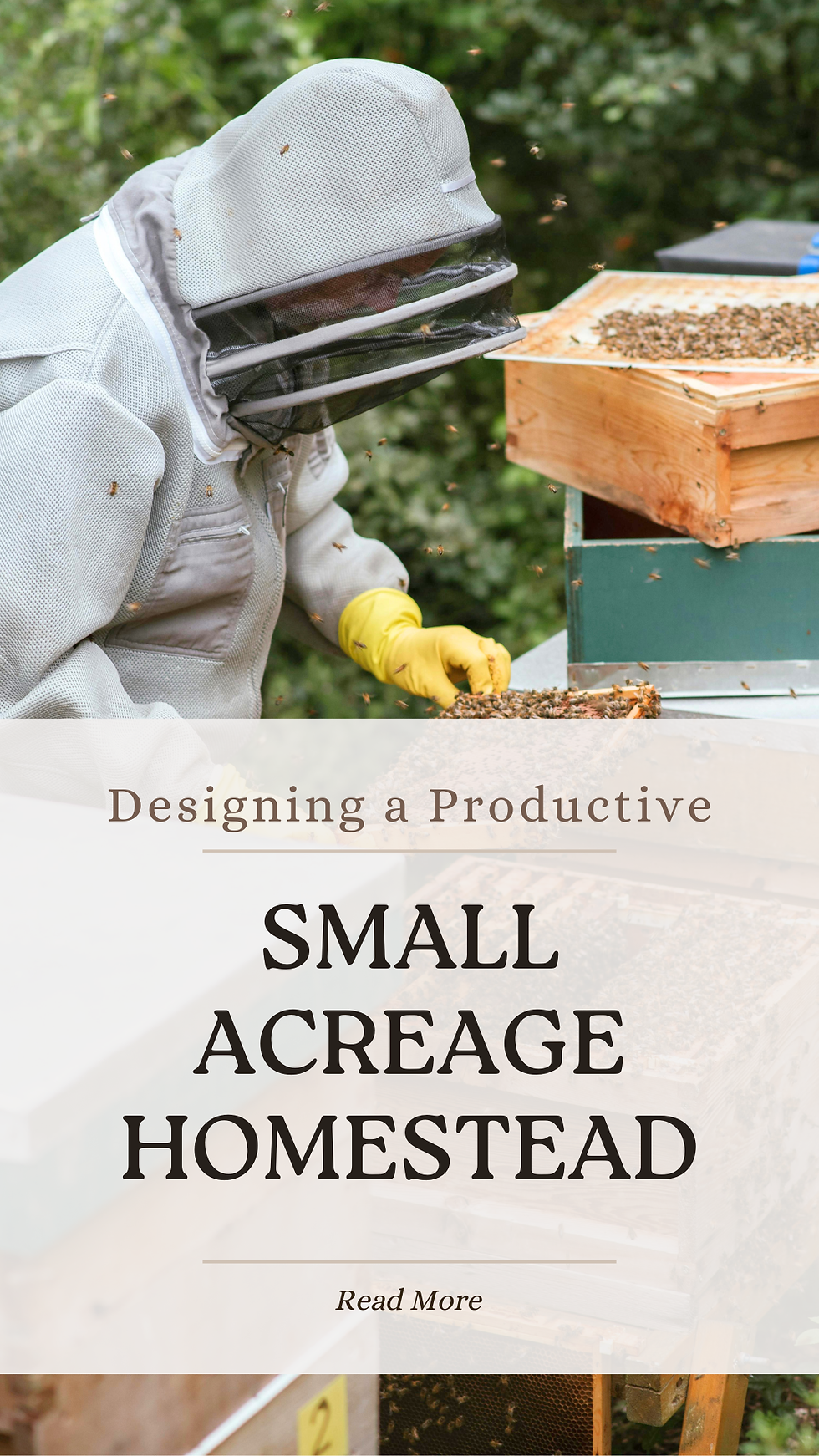
Bees
Bees are one of the highest-impact additions you can make — and they take up almost no space.
Here’s what they bring to your homestead:
Pollination boost - Your garden, fruit trees, and flowering plants all benefit immediately.
Honey production - A tangible, usable product from a very small footprint.
Stronger ecosystem health - Bees support everything else you’re growing.
And unlike most livestock, bees don’t compete for space — they expand what your land is capable of.
If you’re serious about self-sufficient living, bees are one of the smartest additions you can make early.
A Note on Adding Animals
Here’s where people get ahead of themselves:
More animals ≠ better homestead.
Each addition should serve a purpose and fit into your system. If it doesn’t improve efficiency or output, it may just be adding work.
Integrating Everything Into a Self-Sufficient System
This is where your homestead stops being a collection of projects and starts functioning like a system.
Stacking Functions on Small Land
Each piece should serve more than one purpose:
Goats → land clearing + manure + food
Chickens → pest control + soil health + eggs/meat
Bees → pollination + honey + ecosystem support
Garden → food production + animal feed + soil building
When these elements start working together, your reliance on outside inputs drops significantly.
That’s what self-sufficient living actually looks like in practice.
Water on a Small Homestead: Capture, Conserve, Reuse

Water management becomes more important the smaller your space is.
And depending on your state, there may be rules around water collection — so always check what’s allowed where you live.
Capture
Rain barrels off gutters
Small cistern systems
Even basic setups can make a noticeable difference.
Conserve
Drip irrigation
Mulching to retain moisture
Watering during cooler parts of the day
Reuse (Where Allowed)
Greywater systems
Redirecting lightly used water to plants
It doesn’t need to be complicated — just intentional.
Common Mistakes in Small Acreage Homesteading (And How to Avoid Them)
A few things that trip people up early:
Adding too many animals too quickly
Underbuilding fencing
Not planning space for feed and storage
Ignoring how systems connect
Trying to do everything at once
Small homesteads reward focus. The more intentional you are, the smoother it goes.
Is Small Acreage Homesteading Worth It? (Real Talk)
It’s not always easy.
There are long days, learning curves, and moments where things don’t go as planned.
But there’s also:
Food you raised yourself
Systems you built from scratch
A level of independence that feels earned
For most people, that trade-off is more than worth it.
Starting Your Own Small Acreage Homestead with Goats
If you’re ready to start:
Start smaller than you think
Build infrastructure first
Add animals intentionally
Let your systems evolve over time
You don’t need a perfect plan — just a thoughtful starting point.
From Our Homestead to Yours
At Inka’s Acres, goats became the foundation of everything we’re building.
They challenged us early (and still do), but they’ve also made our land more productive, more dynamic, and honestly — more fun.
If we were starting over, we’d still choose goats.
We’d just respect fencing a lot sooner.
Final Thoughts: You Don’t Need More Land—You Need Better Systems
Small acreage homesteading works because it forces you to be intentional.
When every piece of your land has a purpose — and those purposes overlap — even a small space can produce more than you expect.
You don’t need a bigger property to start building this kind of life.
You just need to start thinking differently about the one you have.


Comments